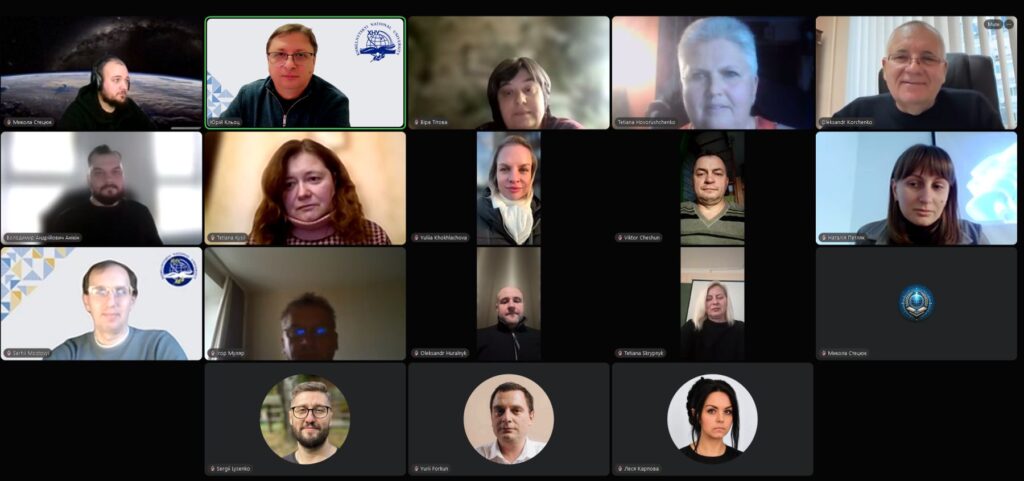
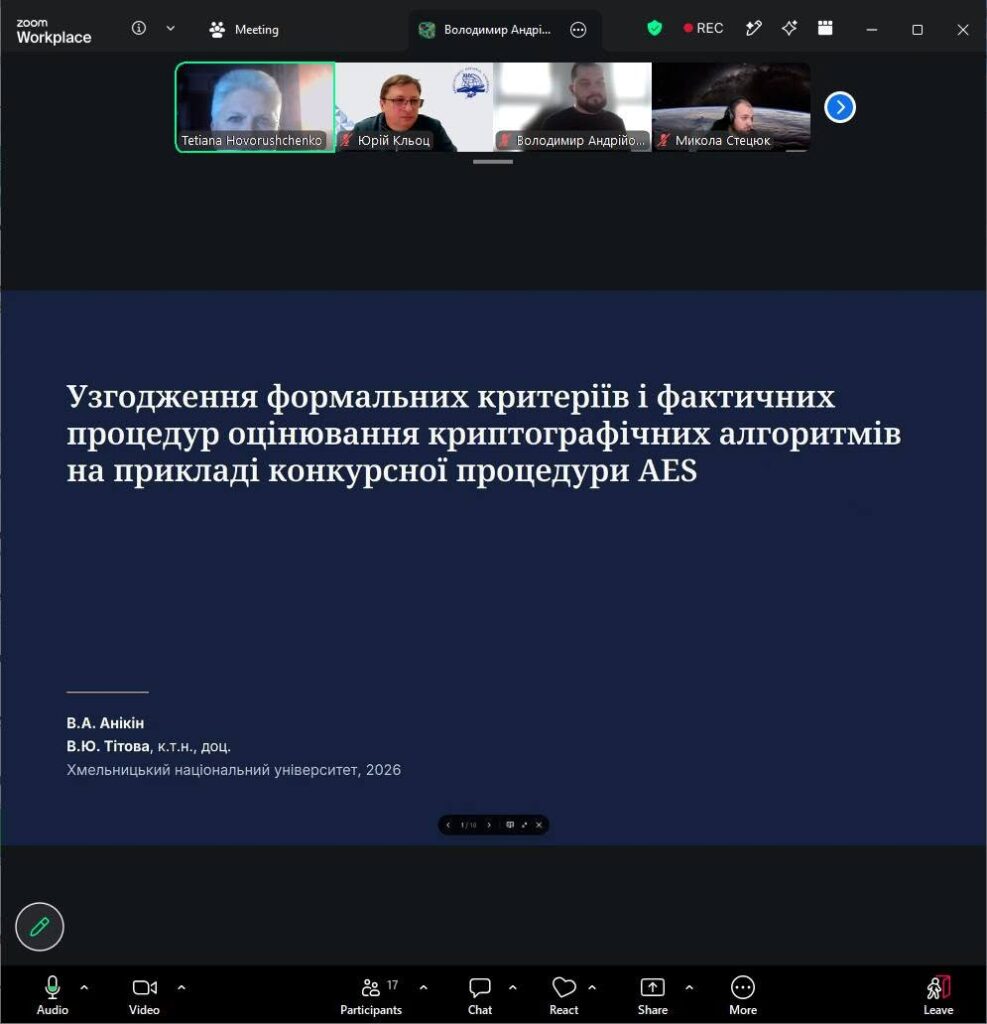
On November 26, 2026, as part of the "Autumn Innovation Week" organized by the Faculty of Information Technologies at Khmelnytskyi National University, a meeting of the Khmelnytskyi regional branch of the scientific-practical seminar "Cybersecurity and Information Protection"—under the Scientific Council on "Cybersecurity in the Energy Sector" of the National Academy of Sciences of Ukraine—took place.
The following individuals addressed the seminar participants with welcoming remarks:
- Oleksandr Korchenko, Corresponding Member of the National Academy of Sciences of Ukraine, Professor, Scientific Supervisor, and Head of the Seminar (State University of Information and Communication Technologies);
- Yuliia Khokhlachova, Professor, Scientific Secretary of the Seminar (State University of Information and Communication Technologies);
- Tetiana Hovorushchenko, Professor, Dean of the Faculty of Information Technologies at Khmelnytskyi National University, and Scientific Supervisor of the Khmelnytskyi Regional Branch of the seminar.
During the meeting, faculty members from the Department of Cybersecurity at Khmelnytskyi National University presented three research papers:
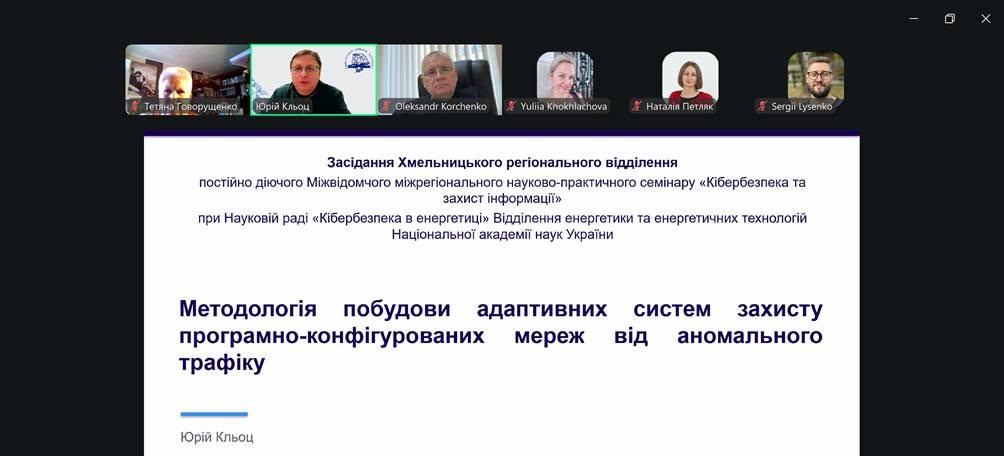
- Yurii Klots, Head of the Cybersecurity Department: “Methodology for Building Adaptive Protection Systems for Software-Defined Networks Against Anomalous Traffic.”
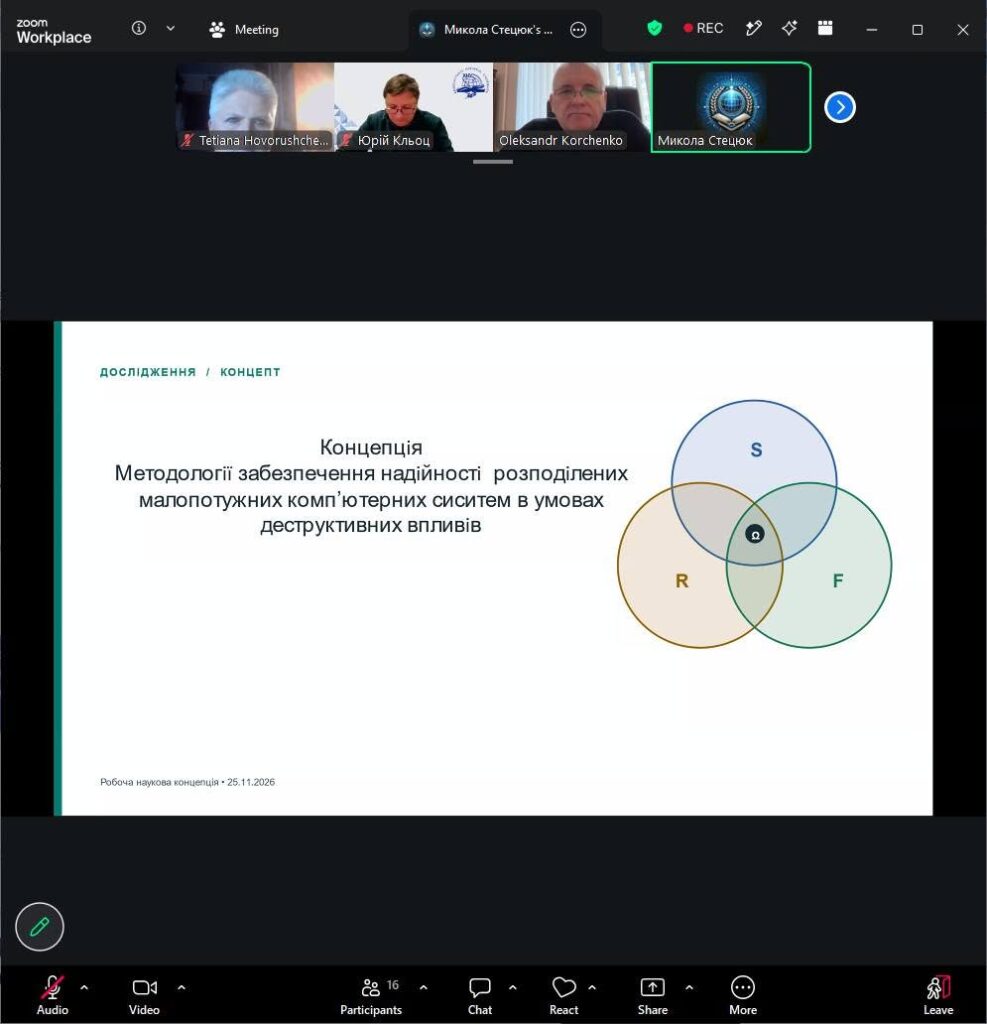
- Mykola Stetsiuk, Associate Professor in the Department of Cybersecurity: "A Concept for Ensuring the Reliability of Distributed Low-Power Computer Systems Under Destructive Influences."
- Volodymyr Anikin, lecturer at the Department of Cybersecurity: "Aligning formal criteria with actual evaluation procedures for cryptographic algorithms: the case of the AES competition process."
The presentations covered key areas of research at the Department of Cybersecurity, specifically the development of adaptive methods and tools for protecting network infrastructure, ensuring the reliability of distributed computer systems under destructive influences, and improving approaches to the evaluation of cryptographic algorithms.
Holding the seminar facilitates the exchange of scientific experience, the development of inter-university cooperation, the discussion of promising research directions, and the formulation of new scientific approaches to ensuring the cybersecurity of information systems and critical infrastructure.
The Department of Cybersecurity expresses its gratitude to the seminar organizers, speakers, and all participants for a substantive scientific discussion, professional dialogue, and fruitful cooperation.